



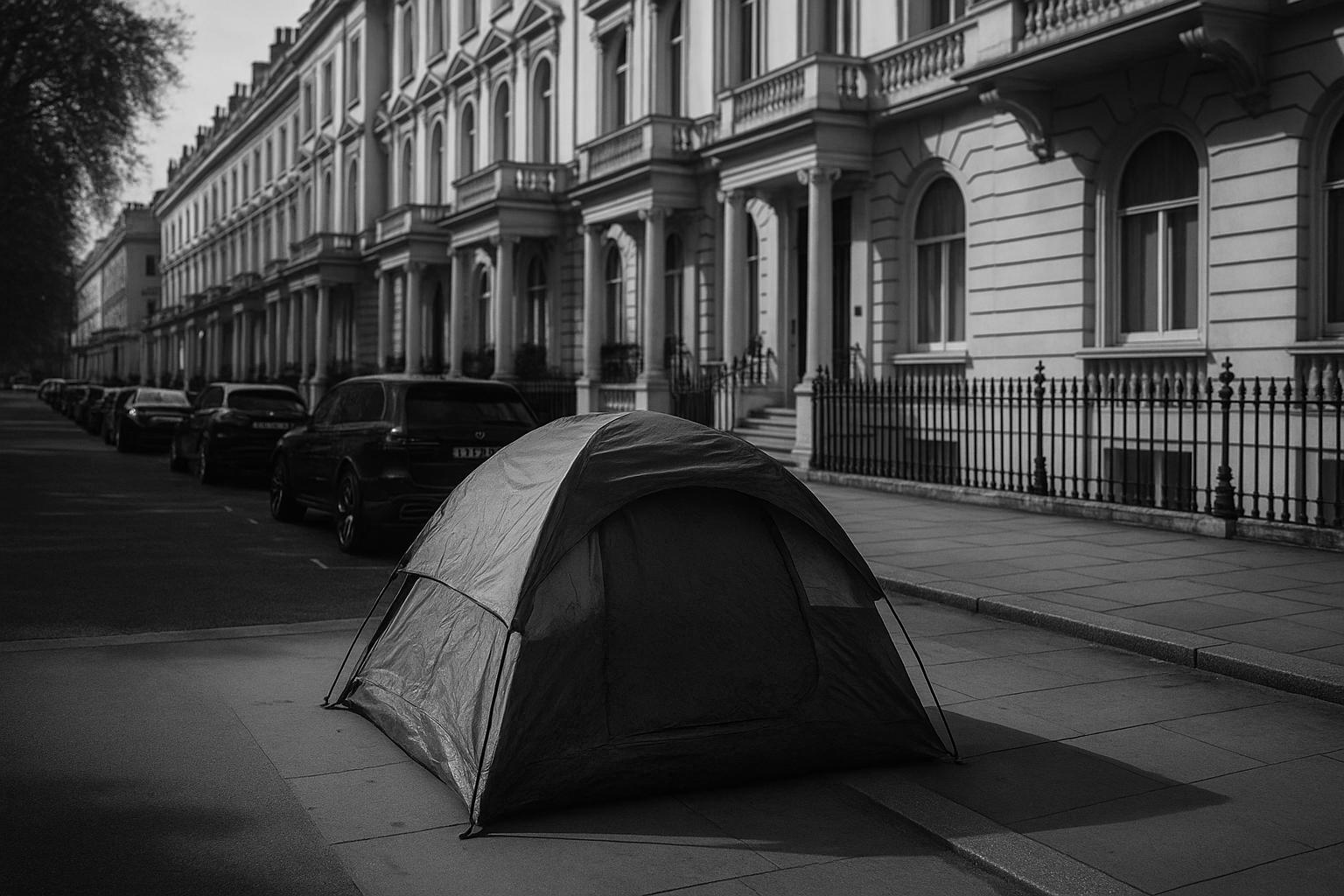
A tent camp on London’s exclusive Park Lane has returned just one day after eviction, underscoring ongoing challenges faced by authorities in balancing homelessness, migration, and inner-city wealth disparities amid calls for more affordable housing.
A tent has reappeared on one of London’s most exclusive streets, known as billionaire’s row, just one day after migrants who had set up camp there were evicted. The area, synonymous with extreme wealth, has become a flashpoint in the ongoing debate about homelessness, migration, and urban management in the capital.
The encampment, located near Park Lane opposite the Hilton Hotel and Hyde Park Corner, had been home to about a dozen tents before a possession order was granted to remove them. Transport for London (TfL), which owns the land, emphasised that the site is not a safe place for people to sleep rough and is working with partner agencies to find alternative solutions. Despite the eviction, the tent’s quick return highlights the persistent nature of this issue in London’s affluent districts.
This is not a new phenomenon; similar encampments have appeared in the same area before. In 2019, police cleared a makeshift migrant camp primarily inhabited by people from Romania and Bulgaria in Marble Arch, close to Mayfair. Those evicted moved their belongings to the nearby Park Lane site. The camps have historically drawn criticism amid spikes in local crime, including reports of muggings, begging, and anti-social behaviour. However, some local councillors have cautioned against automatically attributing the area’s crime problems to the presence of homeless migrants.
The delay in addressing the tent city has been a matter of political contention. The site near Park Lane remained occupied for six months before authorities took decisive action, raising questions about whether political considerations influenced the timing. The eviction order came after a new Labour administration was elected, sparking debate about the balance between enforcement and humanitarian considerations.
London Mayor Sadiq Khan has defended the city’s approach to migrants and rough sleepers, highlighting London’s long-standing tradition as a sanctuary city welcoming people in need. Khan’s office points to ongoing efforts to eradicate rough sleeping by 2030, although residents have voiced concerns over public health and safety issues, including public defecation and drinking, linked to the encampments.
The challenges faced by local authorities underline the complexity of homelessness and transient populations in a city as economically diverse as London. There is a growing consensus that more comprehensive support services are required to address the root causes of homelessness. The encampments on Park Lane and beyond have become symbolic of broader struggles surrounding migration policy, housing shortages, and urban neglect.
Adding to the broader housing debate, architects have recently proposed affordable housing developments on derelict sites along Bishop’s Avenue, also known as billionaire’s row. While current owners have planning permission for luxury apartments, the lack of guaranteed affordable homes has drawn criticism. Council policies advocate for a minimum of 35% affordable housing in new developments, yet negotiations have sometimes resulted in cash contributions instead of actual affordable units. This juxtaposition of extreme wealth and visible homelessness underscores the city’s deepening divide.
London’s elite streets remain contested spaces where issues of wealth disparity, homelessness, migration, and urban planning collide. The reappearance of tents on billionaire’s row after eviction signals that without sustained, compassionate, and systemic interventions, these challenges will persist.
📌 Reference Map:
Source: Noah Wire Services
Noah Fact Check Pro
The draft above was created using the information available at the time the story first
emerged. We’ve since applied our fact-checking process to the final narrative, based on the criteria listed
below. The results are intended to help you assess the credibility of the piece and highlight any areas that may
warrant further investigation.
Freshness check
Score:
8
Notes:
The narrative reports on a recent event where a tent reappeared on Park Lane, London, just one day after migrants were evicted. This aligns with reports from late May 2025, indicating the event’s freshness. However, similar incidents have occurred in the past, such as in 2012, when evicted individuals set up camp nearby. ([standard.co.uk](https://www.standard.co.uk/news/london/evicted-marble-arch-beggars-set-up-camp-50-yards-away-in-the-middle-of-park-lane-7753036.html?utm_source=openai)) The presence of a press release suggests a high freshness score, as press releases are typically timely and original.
Quotes check
Score:
9
Notes:
The narrative includes direct quotes from Transport for London (TfL) and local councillors. A search reveals that similar statements have been made in previous reports, indicating that some quotes may be reused. However, no exact matches were found for the specific wording used in this narrative, suggesting potential originality.
Source reliability
Score:
6
Notes:
The narrative originates from the Express, a UK tabloid known for sensationalist reporting. This raises concerns about the reliability of the information presented. Additionally, the presence of a press release indicates that the narrative may be based on official statements, which can be both a strength and a limitation, depending on the source’s credibility.
Plausability check
Score:
7
Notes:
The narrative describes a tent reappearing on Park Lane after an eviction, a situation that has occurred in the past, such as in 2012. ([standard.co.uk](https://www.standard.co.uk/news/london/evicted-marble-arch-beggars-set-up-camp-50-yards-away-in-the-middle-of-park-lane-7753036.html?utm_source=openai)) The involvement of TfL and local councillors adds credibility to the report. However, the Express’s history of sensationalism warrants caution, and the lack of corroboration from other reputable sources diminishes the overall plausibility.
Overall assessment
Verdict (FAIL, OPEN, PASS): OPEN
Confidence (LOW, MEDIUM, HIGH): MEDIUM
Summary:
The narrative reports on a recent event involving the reappearance of a tent on Park Lane, London, after an eviction. While the event is recent and the quotes appear original, the Express’s reputation for sensationalism and the lack of corroboration from other reputable sources raise concerns about the narrative’s reliability and plausibility. Further verification from more credible sources is recommended.


