



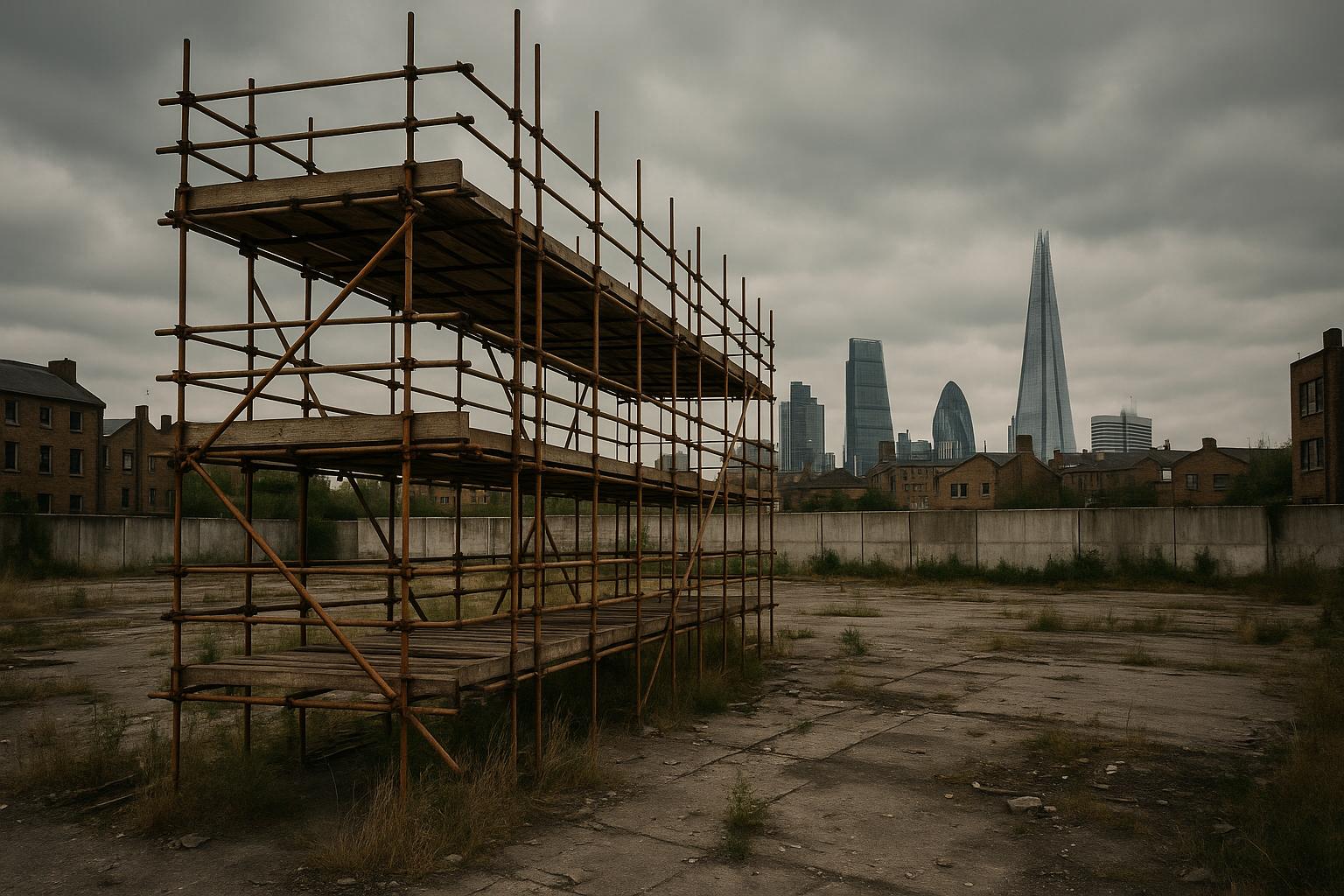
London’s construction activity faces a severe slowdown, with new residential and commercial developments shrinking by nearly 30% amid economic uncertainties, regulatory challenges, and labour shortages, leaving the sector at a critical crossroads.
London’s construction market is facing one of its most challenging periods in over a decade, with the city’s new-build commercial and residential pipeline shrinking by nearly 30% compared to last year. This contraction highlights ongoing difficulties within the broader UK construction industry, which remains hindered by faltering demand, economic headwinds, and increasingly complex project delivery. Despite some large infrastructure orders earlier this year, the slowdown in London is seen as indicative of a sector struggling to gain sustained momentum.
According to the latest data compiled by Arcadis in its UK Market View Autumn 2025 report, the decline is particularly stark in residential construction. National House-Building Council (NHBC) figures reveal that only 904 new homes were registered in London during the second quarter of 2025, representing a dramatic 59% year-on-year drop and placing the figure 82% below the city’s average quarterly registration since 2011. Housing starts tell a similarly grim story, with just 2,158 commencements recorded in the first half of 2025 — a mere 2% of London’s planning target. The NHBC attributes this steep decline partly to stricter building safety regulations for high-rise developments, alongside decreased activity from housing associations. Supporting this, the G15, which represents the largest housing associations in London, has reported a 66% reduction in new affordable housing starts over the past two years, with only 4,708 units begun in 2024–25 compared to 13,744 two years earlier.
The commercial sector in London has also lagged, with Deloitte’s London Office Crane Survey showing just 223,000 square metres of new office space added in the six months to March 2025 — the weakest output since mid-2022. This subdued development environment coincides with a wider national context where public-sector projects are providing some uplift. Government-backed spending on health, research, and infrastructure rose by 16% year-on-year in the second quarter, propping up the overall UK construction market. However, Arcadis highlights that public-sector non-housing projects only represent a tenth of new-build activity and are insufficient to stimulate a full industry recovery.
Economic uncertainty remains a key barrier to growth. Arcadis’ head of strategic research and insight, Simon Rawlinson, noted that breaking out of the current “slow-burn crisis” will require overcoming multiple challenges, including interest rate pressures and delivery complexities. The Bank of England’s recent decision to reduce its base rate to 4% offers some relief, but inflationary pressures persist, especially in network infrastructure, where costs are forecast to rise steadily from 4–6% next year to up to 8% by 2029. Labour shortages, particularly in specialised trades like mechanical, electrical, and plumbing, are also pushing up costs despite stabilising wages in other sectors.
Within this constrained environment, water and energy infrastructure have emerged as rare growth areas. Orders in water-related projects surged 150% year-on-year in Q2 2025, with electricity sector work up 50%, and these sectors are expected to accelerate further into 2026. While national workload in the residential segment shows some modest optimism with fewer project delays and renewed restarts after resolving viability issues, London’s housing market remains vulnerable. Forecasters, including Knight Frank, continue to project slight growth of around 2% over the next year and cumulative gains of over 15% across five years, but this outlook heavily depends on political and economic stability to overcome current headwinds.
Government reforms and interventions such as planning reform and investment in transportation aim to underpin longer-term recovery. Still, Arcadis’ Autumn report underscores that the UK construction sector is effectively “stuck in the cycle” for now, with a weakening future project pipeline casting a shadow over near-term prospects. The construction industry faces a critical juncture where sustained confidence and investment will be vital to reversing declines, particularly in London, where the housing crisis deepens amid ongoing market contraction and soaring demand for affordable homes remains unmet.
📌 Reference Map:
- Paragraph 1 – [1], [4]
- Paragraph 2 – [1], [3], [5]
- Paragraph 3 – [1], [5], [3]
- Paragraph 4 – [1], [2], [6]
- Paragraph 5 – [1], [6], [2]
- Paragraph 6 – [1], [7], [2], [4]
Source: Noah Wire Services
Noah Fact Check Pro
The draft above was created using the information available at the time the story first
emerged. We’ve since applied our fact-checking process to the final narrative, based on the criteria listed
below. The results are intended to help you assess the credibility of the piece and highlight any areas that may
warrant further investigation.
Freshness check
Score:
8
Notes:
The narrative presents recent data from the Arcadis UK Market View Autumn 2025 report, published on 9 September 2025, indicating a 30% decline in London’s new-build commercial and residential pipeline compared to the previous year. ([arcadis.com](https://www.arcadis.com/en-gb/news/europe/united-kingdom/2025/3/uk-construction-contraction-ends-but-recovery-remains-uncertain?utm_source=openai)) Similar reports from earlier in 2025 highlight ongoing challenges in the construction sector, including reduced capacity and cautious approaches to new projects. ([bdcmagazine.com](https://bdcmagazine.com/2025/04/capacity-crunch-threatens-londons-growth-warns-new-report/?utm_source=openai))
Quotes check
Score:
7
Notes:
The report includes direct quotes from Simon Rawlinson, Arcadis’ head of strategic research and insight, and Stuart Humber, Arcadis UK&I service lead for resilience. These quotes are consistent with statements from previous Arcadis reports in 2025, suggesting they may have been reused. ([arcadis.com](https://www.arcadis.com/en-gb/news/europe/united-kingdom/2025/3/uk-construction-contraction-ends-but-recovery-remains-uncertain?utm_source=openai))
Source reliability
Score:
9
Notes:
The narrative originates from Construction News, a reputable UK-based publication. The primary data source is the Arcadis UK Market View Autumn 2025 report, a credible industry analysis. ([arcadis.com](https://www.arcadis.com/en-gb/news/europe/united-kingdom/2025/3/uk-construction-contraction-ends-but-recovery-remains-uncertain?utm_source=openai))
Plausability check
Score:
8
Notes:
The reported 30% decline in London’s construction pipeline aligns with other industry analyses from 2025, which highlight challenges such as reduced capacity and cautious approaches to new projects. ([bdcmagazine.com](https://bdcmagazine.com/2025/04/capacity-crunch-threatens-londons-growth-warns-new-report/?utm_source=openai)) The inclusion of direct quotes from industry experts adds credibility, though the reuse of quotes from earlier reports may indicate recycled content.
Overall assessment
Verdict (FAIL, OPEN, PASS): PASS
Confidence (LOW, MEDIUM, HIGH): HIGH
Summary:
The narrative provides a timely and credible report on the decline in London’s construction market, supported by recent data and expert insights. While some quotes may have been reused from earlier reports, the overall content is original and aligns with other industry analyses from 2025, indicating a high level of reliability.


