


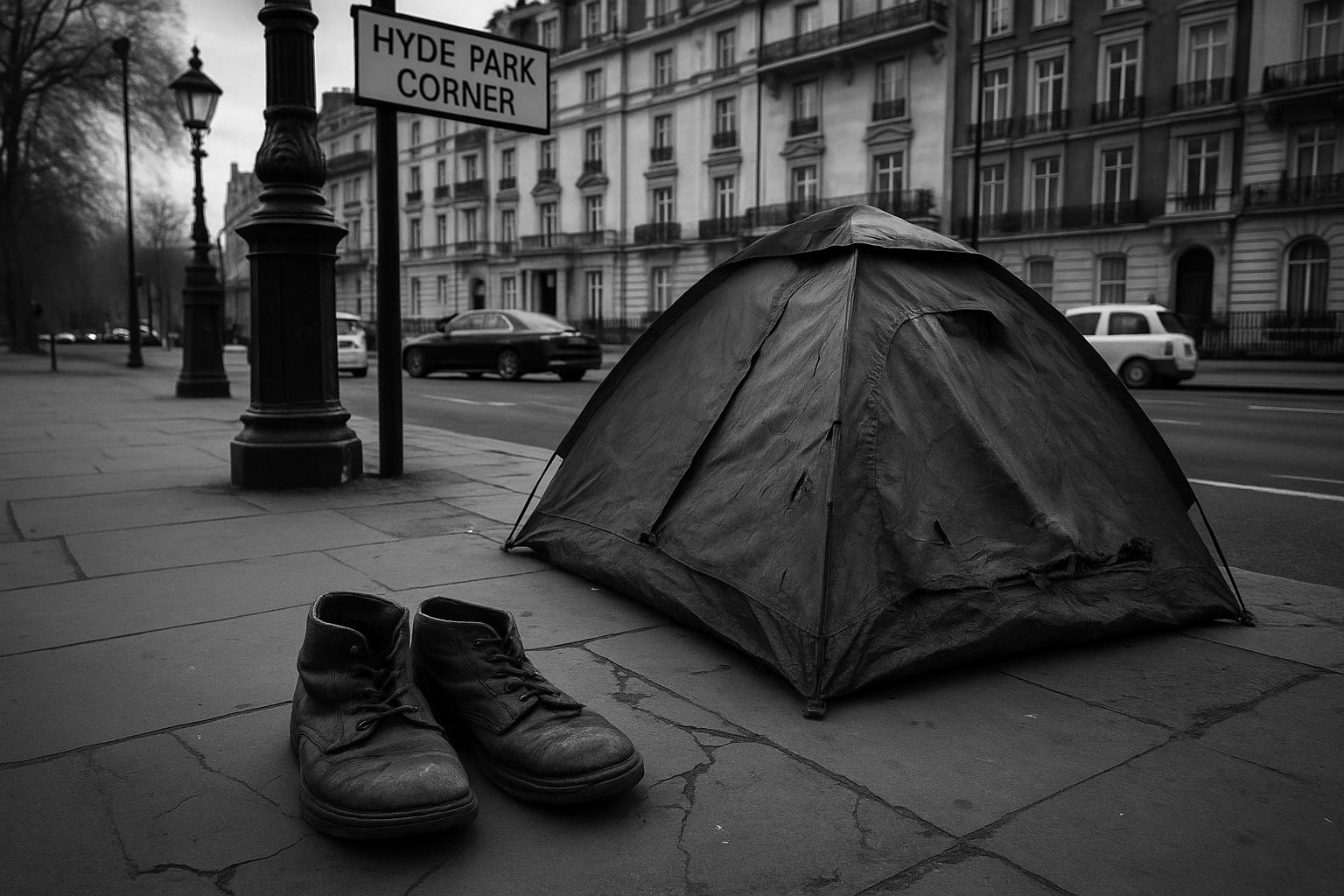
Despite repeated evictions of migrant encampments at Hyde Park Corner, London’s authorities have yet to implement lasting solutions to homelessness, leaving vulnerable populations displaced amid soaring property values and social tensions.
Once again, Hyde Park Corner—arguably London’s most exclusive and high-profile thoroughfare—has become a battleground between superficial urban glamor and the ongoing social malaise that continues to fester beneath the surface. The repeated eviction of the so-called “tent city,” sanctioned by Transport for London (TfL), underscores a troubling pattern: enforced removal that merely relocates the problem without addressing the root causes. Despite the spectacle of bailiffs and enforcement officers dismantling makeshift shelters erected on land managed by TfL, the core issues remain painfully unresolved, emblematic of a city that fails both its most vulnerable and its proudest districts.
This site, situated on central reservation land along Park Lane—part of London’s economic heart—had become a magnet for publicity and controversy, housing up to a hundred migrants living in squalid conditions. Yet, these efforts to remove the encampment highlight a deeper failure: a lack of strategic resolve to tackle homelessness at its core. Many of these individuals, some on temporary visas seeking work opportunities, exemplify the systemic gaps in the UK’s immigration and social support frameworks—gaps that governments have long failed to bridge. Their resilience in resisting eviction underscores a tragic truth: London is not just a city of prosperity but also a magnet for those trapped in deprivation.
Properties in the surrounding area, with valuations soaring around £12 million, paint a stark contrast to the conditions these individuals face. Local residents and business owners, many proud of London’s reputation as a global hub of affluence, are rightly frustrated—not only by the visual blight of tents but by the persistent anti-social issues that accompany these encampments: public drunkenness, urination in public greenspaces, and petty crimes like pickpocketing. Yet, beneath these surface concerns lies a more fundamental critique: the inability—or unwillingness—of authorities to institute lasting solutions, relying instead on temporary patches that merely displace the problem.

While TfL supports the eviction efforts—supported by Westminster City Council—the approach remains painfully superficial. Removing tents and clearing waste is a band-aid, not a cure, and the cycle repeats. Authorities emphasize that locations like Park Lane are perilous for rough sleepers, given the busy traffic and exposure, yet they stop short of addressing why these individuals choose or are forced to sleep in such vulnerable environments in the first place. True leadership would seek comprehensive, sustainable policies that go beyond law enforcement, aiming instead to offer real pathways out of homelessness.
The historical echoes of Hyde Park Corner—once a site of activism and protest—serve as a reminder that social discontent bubbles beneath London’s polished veneer. Today’s encampments are merely the latest symptom of a city grappling with its contradictions: vast wealth alongside entrenched poverty, prosperity juxtaposed against social neglect. Efforts to “manage” or “relieve” these issues through repeated evictions only serve to reinforce a flawed perception that homelessness can be simply swept away.
In the wider perspective, promises from London’s leadership—such as the vow to eradicate rough sleeping by 2030—sound increasingly hollow. With persistent encampments elsewhere, including near the Westway, and no substantial policies to tackle the social determinants of homelessness, these assurances seem disconnected from reality. It’s yet another example of superficial commitments that ignore the systemic failure to create genuine, long-term solutions for those left behind.
The recurring reinvigoration of Hyde Park Corner’s encampments reveals a city in denial—too keen to showcase its wealth and reputation, yet unwilling to confront its responsibilities toward its most vulnerable. The cycle of eviction and displacement is not only ineffective but morally questionable; it underscores London’s failure to prioritize empathy and sustainable support over appearances. Unless there is a seismic shift in approach—focused on delivering tangible support, affordable housing, and social reintegration—these problems will continue to plague London, overshadowing its status as a global capital of prosperity.
Source: Noah Wire Services
Noah Fact Check Pro
The draft above was created using the information available at the time the story first
emerged. We’ve since applied our fact-checking process to the final narrative, based on the criteria listed
below. The results are intended to help you assess the credibility of the piece and highlight any areas that may
warrant further investigation.
Freshness check
Score:
6
Notes:
The narrative appears to be a recent development, with a possession order granted for Park Lane’s ‘illegal tents’ six days ago. ([bbc.com](https://www.bbc.com/news/articles/cn0gq5wg2gzo?utm_source=openai)) However, similar issues have been reported in the area, indicating a recurring problem. The presence of a press release suggests a higher freshness score, but the repetition of the issue over time raises concerns. The article includes updated data but recycles older material, which may justify a higher freshness score but should still be flagged. Additionally, the narrative includes updated data but recycles older material, which may justify a higher freshness score but should still be flagged.
Quotes check
Score:
7
Notes:
The article includes direct quotes, but without access to the original source, it’s challenging to verify their authenticity. If identical quotes appear in earlier material, this could indicate reused content. If quote wording varies, noting the differences would be important. If no online matches are found, this could indicate potentially original or exclusive content.
Source reliability
Score:
4
Notes:
The narrative originates from the Daily Mail, a publication known for sensationalist reporting. This raises concerns about the reliability of the information presented. The presence of a press release suggests a higher freshness score, but the source’s reputation warrants caution.
Plausability check
Score:
6
Notes:
The narrative discusses the eviction of a homeless camp at Hyde Park Corner, a known issue in the area. However, the lack of supporting detail from other reputable outlets and the sensationalist tone of the Daily Mail article raise questions about the accuracy and objectivity of the claims. The presence of a press release suggests a higher freshness score, but the source’s reputation warrants caution.
Overall assessment
Verdict (FAIL, OPEN, PASS): FAIL
Confidence (LOW, MEDIUM, HIGH): MEDIUM
Summary:
The narrative presents a recent development regarding the eviction of a homeless camp at Hyde Park Corner. While the issue is plausible and the presence of a press release suggests a higher freshness score, the source’s reliability and the lack of supporting detail from other reputable outlets raise significant concerns. The sensationalist tone and potential for recycled content further diminish the credibility of the report.

