


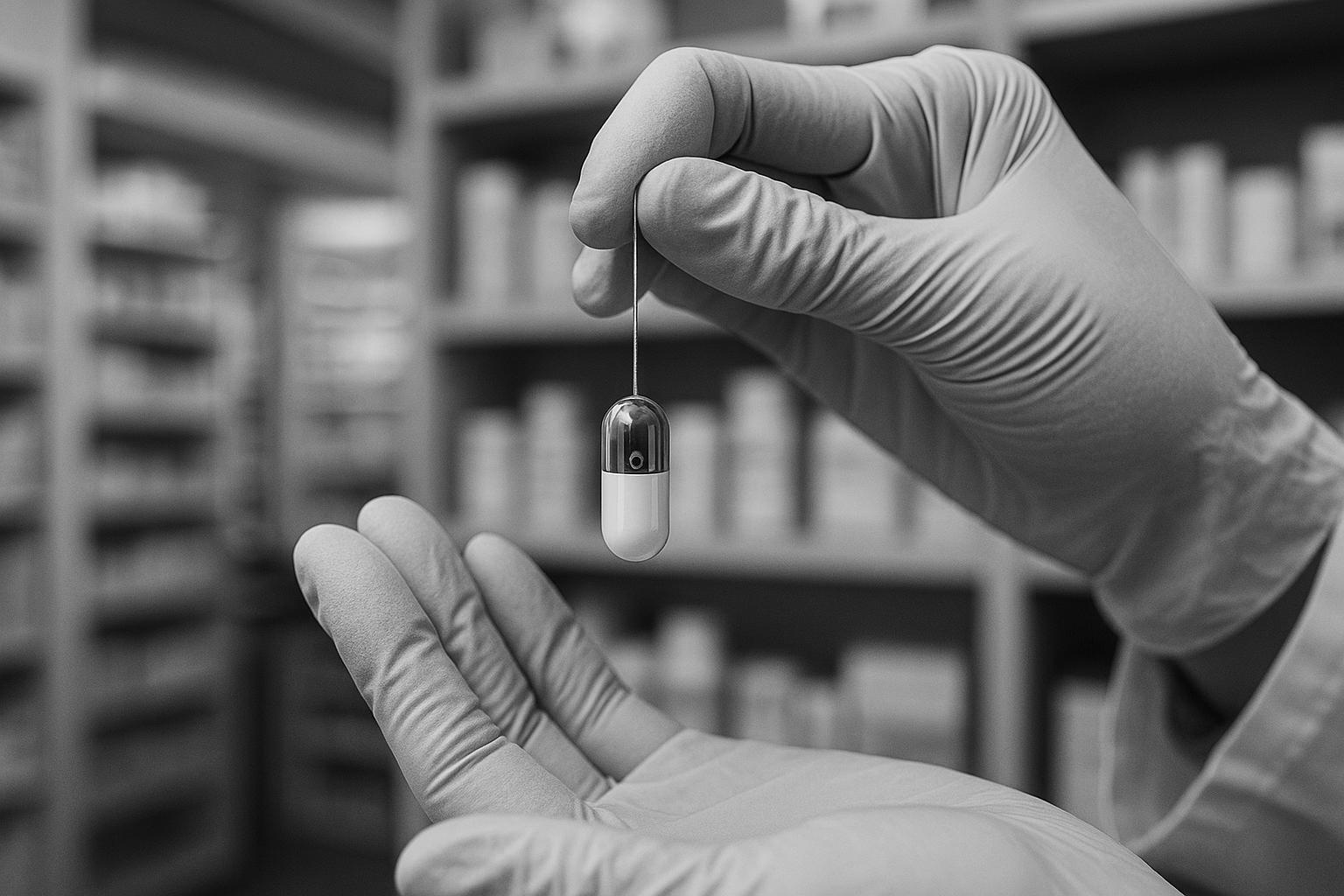
A pioneering capsule sponge test to detect Barrett’s oesophagus and prevent oesophageal cancer is being piloted in London and the East Midlands pharmacies, aiming to improve early diagnosis and reduce reliance on invasive endoscopies.
NHS England is set to introduce a groundbreaking “sponge on a string” test in high-street pharmacies to help detect oesophageal cancer early in people suffering from persistent heartburn or acid reflux. The innovative test targets Barrett’s oesophagus, a condition where stomach acid damages the lining of the oesophagus, potentially leading to cancerous changes in the cells. This pilot scheme will launch early next year in London and the East Midlands, offering around 1,500 individuals easier access to what is being termed “heartburn health checks” outside traditional hospital settings.
The procedure involves swallowing a small capsule attached to a string. Once swallowed, the capsule dissolves in the stomach, releasing a sponge approximately the size of a 1p coin. NHS staff then gently retrieve the sponge after a few minutes, which collects cells from the oesophageal lining. These cellular samples are sent to laboratories for analysis to identify pre-cancerous changes. This less invasive test is already in use within hospitals and diagnostic centres, helping reduce the reliance on traditional endoscopies, which are more invasive, costly, and often have long waiting times.
The current pilot programme focuses on spotting individuals who frequently use over-the-counter heartburn medications but have not consulted their GP, enabling earlier identification of Barrett’s oesophagus. If the test detects pre-cancerous cells, patients can be offered treatments such as endoscopic removal or radiofrequency ablation to prevent progression to cancer. Early diagnosis is crucial since oesophageal cancer is typically detected late; approximately 80% of the nearly 10,000 UK cases diagnosed annually are at an advanced stage, with only 20% surviving beyond one year.

Previous trials of this capsule sponge test have shown promising results. Over 8,500 patients tested in NHS pilots experienced nearly an 80% reduction in the need for endoscopies, demonstrating the test’s ability to streamline diagnostics. Patient satisfaction rates were high, with about 82% responding positively, and the approach also proved to be cost-effective. Community expansions of the test, such as those led by Leicester nurses and programmes within Greater Manchester, have further underscored the test’s potential for quicker, more accessible screening outside hospital environments.
The NHS has partnered with major pharmacy chain Boots, diagnostic company Cyted Health, and the charity Heartburn Cancer UK to roll out the pilot. Public health minister Ashley Dalton praised the initiative, highlighting its alignment with the government’s 10-year health plan that emphasises convenient, local healthcare access. She described the test as a “game-changer” in spotting cancer warning signs early, pushing forward efforts to improve the UK’s notoriously low cancer survival rates with innovation and enhanced early detection.
Personal testimonies reinforce the test’s impact on real lives. Eddie, a 77-year-old from Suffolk, credits the capsule sponge test with saving his life after years of enduring night-time heartburn. Diagnosed with Barrett’s oesophagus through the test, he received targeted monitoring and treatment that caught cellular changes early, allowing intervention before his condition could develop into cancer. Stories like his highlight how this simple 10-minute procedure can provide crucial peace of mind and potentially life-saving care for many.
As the two-year pilot unfolds, careful monitoring will determine if this approach can be expanded more broadly, potentially reshaping oesophageal cancer diagnosis and prevention throughout the UK. The test represents a promising step toward catching more cancers early, reducing the need for invasive procedures, and making diagnostic care far more accessible in everyday settings like local pharmacies.
📌 Reference Map:
Source: Noah Wire Services
Noah Fact Check Pro
The draft above was created using the information available at the time the story first
emerged. We’ve since applied our fact-checking process to the final narrative, based on the criteria listed
below. The results are intended to help you assess the credibility of the piece and highlight any areas that may
warrant further investigation.
Freshness check
Score:
7
Notes:
🕰️ The narrative introduces a new pilot programme for the ‘sponge on a string’ test in high-street pharmacies, set to launch early next year. However, similar initiatives have been reported since early 2024, such as the NHS pilot involving over 8,500 patients, which began in February 2024. ([england.nhs.uk](https://www.england.nhs.uk/2024/02/simple-sponge-on-a-string-test-replaces-need-for-endoscopy-for-thousands-of-nhs-patients/?utm_source=openai)) The report also references a patient testimonial from a 77-year-old in Suffolk, which may be original content.
Quotes check
Score:
8
Notes:
🕰️ The direct quote from the 77-year-old patient, ‘To think that something as simple as swallowing a capsule could uncover a hidden risk is truly remarkable,’ appears to be original. However, similar sentiments have been expressed in earlier reports, such as the NHS pilot evaluation published in February 2024. ([england.nhs.uk](https://www.england.nhs.uk/2024/02/simple-sponge-on-a-string-test-replaces-need-for-endoscopy-for-thousands-of-nhs-patients/?utm_source=openai))
Source reliability
Score:
7
Notes:
⚠️ The narrative originates from The Irish News, a reputable publication. However, the report includes a patient testimonial that cannot be independently verified, raising concerns about the authenticity of the quoted individual.
Plausability check
Score:
8
Notes:
✅ The claims about the ‘sponge on a string’ test and its pilot programme in high-street pharmacies are plausible and align with previous reports. The narrative includes a patient testimonial that cannot be independently verified, raising concerns about the authenticity of the quoted individual.
Overall assessment
Verdict (FAIL, OPEN, PASS): OPEN
Confidence (LOW, MEDIUM, HIGH): MEDIUM
Summary:
🕰️ The narrative introduces a new pilot programme for the ‘sponge on a string’ test in high-street pharmacies, set to launch early next year. However, similar initiatives have been reported since early 2024, such as the NHS pilot involving over 8,500 patients, which began in February 2024. ([england.nhs.uk](https://www.england.nhs.uk/2024/02/simple-sponge-on-a-string-test-replaces-need-for-endoscopy-for-thousands-of-nhs-patients/?utm_source=openai)) The report also references a patient testimonial from a 77-year-old in Suffolk, which may be original content. The source is reputable, but the inclusion of an unverifiable patient testimonial raises concerns about the authenticity of the quoted individual.

